
FESTIM Fellowship — Tez Orr#
UKAEA · First FESTIM Fellow · 2026
Tez is a physicist and materials scientist at UKAEA — and our very first FESTIM Fellow. She joined the FESTIM development team at MIT for two months in 2026 to master FESTIM v2 and bring that expertise back to UKAEA.
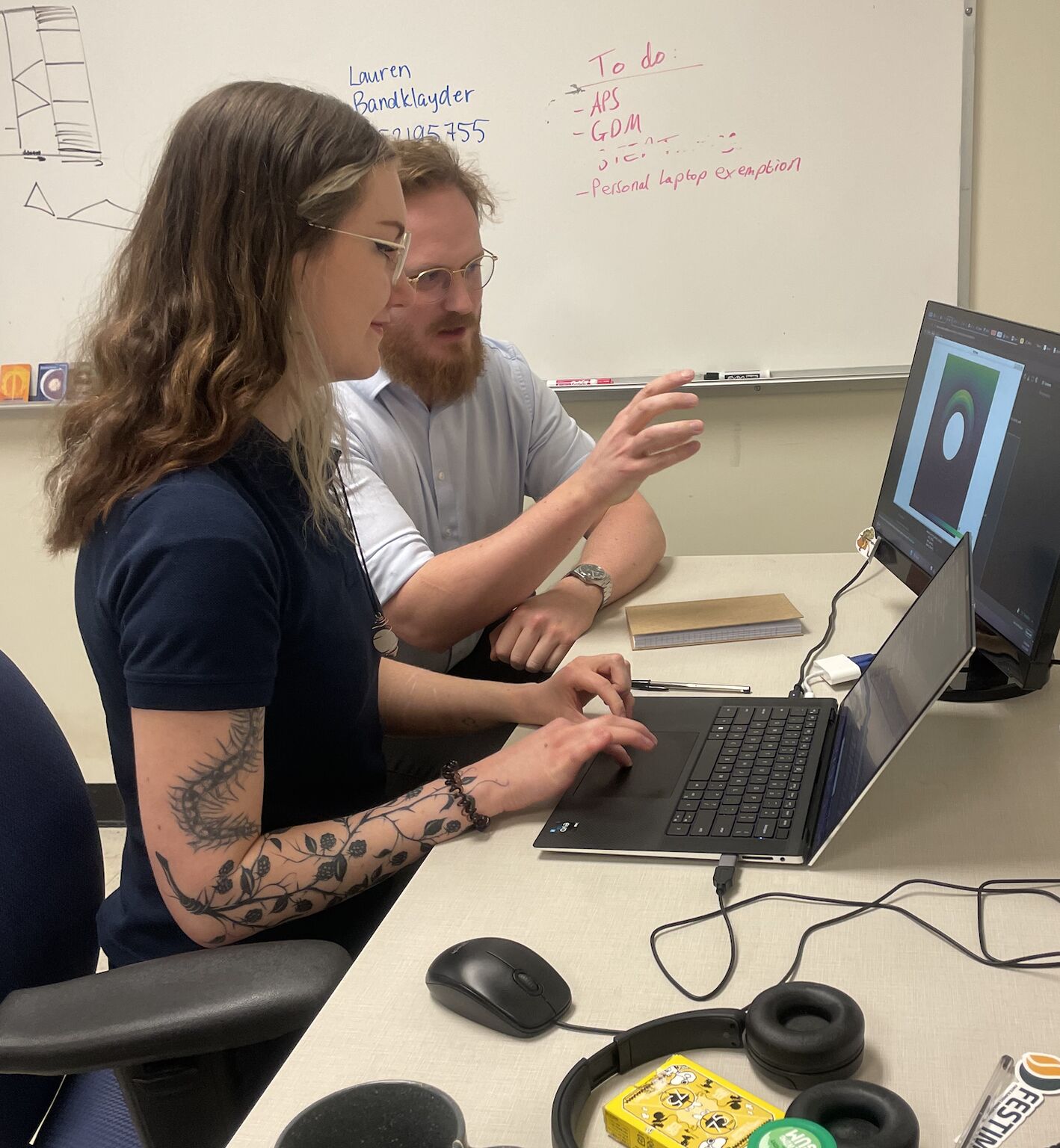
Tez at MIT during her fellowship.#
🗓️ 2 months at MIT — in person
🐛 1 bug fixed — contributed directly to FESTIM v2
🔬 LIBRTI + STEP — UKAEA programmes now using FESTIM
“Even though it’s quite nice to be the FESTIM v2 expert on site (!!!), I would absolutely recommend the programme to my colleagues.”
—Tez, UKAEA
Background & Motivation#
1. What’s your background, and what drew you to apply for the FESTIM Fellowship?
I have a physics and materials science background. I have worked on modelling of tritium transport in plasma facing components and lithium-based tritium breeders in the past using FESTIM and COMSOL. I was interested to try out the FESTIM fellowship as FESTIM v1 was the first modelling code I worked with and learning to use it for the cases I was looking at was quite easy. The FESTIM fellowship meant that I could learn the new capabilities of FESTIM v2 to help with more advanced tritium transport modelling in breeders at UKAEA while developing my own modelling skillset.
2. What was your experience with FESTIM before starting the fellowship?
I had used FESTIM v1.4 when I started working at UKAEA to model tritium transport in STEP-like plasma facing components. I began using FESTIM because it could implement tritium trapping and boundary conditions easily. I also used FESTIM v1.4 to make a faux model of multi-level trapping in a material.
3. What specific project did you bring to the fellowship, and why was it important to your work at UKAEA?
I had hoped to learn FESTIM v2 capabilities and work closely with the FESTIM team as part of my development, so I only brought the plasma facing component, specifically a monoblock, case to the fellowship to learn based off something I knew the results of already. This meant that I could push the limits of the model, exploring edge cases, and know what to expect out of the model.
The Experience#
4. How would you describe working with the FESTIM development team? Were there any standout moments or interactions?
I had a wonderful time working with the FESTIM development team, they were very easy to talk to and would answer any questions I had with enthusiasm. It was really helpful to have them so close by so that anytime I was making a bit of a silly mistake, it could be picked up quickly and not cause too much disruption to my work, while working alone and in a different country, it would likely take much longer to pick up on such mistakes.
5. What was the most challenging aspect of your project, and how did the fellowship help you overcome it?
I found it hard to wrap my head around FEniCSx but understood the importance of being familiar with the foundations of FESTIM to be able to use it optimally. The fellowship gave me the opportunity to learn about FEniCSx in a way that wasn’t just reading their documentation but included using my cases in FEniCSx to understand it better.
6. Did you participate remotely or visit MIT in person? How did that work for you?
I participated in person which meant living abroad for the two-month duration of the fellowship. This was quite a scary thing to do, personally, but meant that I got to be close, and in the same time zone, as the FESTIM development team so that they were much more accessible when I needed to ask anything. This massively increased my efficiency of my modelling work using FESTIM v2 as any issues could be brought up and figured out together within the hour.
7. Can you share a specific example of when you felt the fellowship really “clicked” for you or when you had a breakthrough?
Although a big challenge, I really appreciated the bug fix I got to help out on when the implicit species did not work in the discontinuous case. It was really interesting to see how an issue like this is approached and to learn how I could contribute to the code by using FESTIM in the way I am, pushing the limits of its capabilities to catch these bugs and improve the code overall.
Learning & Impact#
8. What’s one advanced FESTIM feature or best practice you discovered during the fellowship that you’ll use going forward?
I think that the multi-species, multi-level occupancy trapping capabilities coupled with a heat transfer problem will be particularly useful for future work I will do on lithium-based breeders. The ability to combine all these features into one, relatively small script is great for making concise models without overcomplicating the workflow. I will also be using all the GitHub knowledge I learnt on secondment going forward as version control and having a repository has become very important to me through the fellowship.
9. How has the fellowship changed the way you approach simulation work or your confidence with the code?
Fairly often, I am convinced that I am the problem when my simulations don’t work, thinking that I have just massively misunderstood something or made a silly mistake somewhere. However, I’ve seen through the fellowship that sometimes it is just the fact that a feature capable of what I’m attempting hasn’t yet been included or there is a bug in the code — and those are good things to find, not problems! It’s also made me a lot more confident in asking for help instead of staying stuck for longer than I have to be, a bad habit of mine.
10. What was the outcome of your project? Did you achieve significant progress, contribute to the codebase, or accomplish something else?
The goal of the fellowship for me and UKAEA was to develop an expert user of the FESTIM code who could then be a reliable point of contact for any future work that may wish to use FESTIM, as well as between UKAEA and the PSFC team of MIT. I feel as if this was accomplished as the LIBRTI project at UKAEA have already asked for work using FESTIM to assist them since I returned from secondment. I also accomplished much more than just a thorough understanding of FESTIM v2 as I used GitHub repositories for the first time and learnt how to contribute to the code, a step in a good direction for the future of my materials modelling career.
Broader Perspective#
11. How do you see FESTIM fitting into UKAEA’s work, and what’s the potential impact of your fellowship experience?
The tritium transport work happening at UKAEA will benefit from FESTIM as we look more into tritium inventory taking in new breeder designs. There is interest from both LIBRTI and STEP to use FESTIM for work along these lines as well as the potential to use FESTIM in a PhD to investigate tritium transport within lithium-based breeder pebbles. The fellowship experience has made me a reliable point of contact for help on getting others started on using FESTIM as well as the ability to create models where they are needed across the organisation.
12. What advice would you give to someone considering applying to the FESTIM Fellowship?
💬 I would tell them to absolutely give it a shot! It’s a great way to learn about a really interesting modelling code while exploring the wider world of computational materials modelling and software development. The FESTIM team were all very welcoming and it was helpful to be a part of the development of not only the code but of all the projects that are using it.
13. Would you recommend the programme to colleagues? Why or why not?
“Even though it’s quite nice to be the FESTIM v2 expert on site (!!!), I would absolutely recommend the programme to my colleagues.”
—Tez, UKAEA
Many different modelling codes are used at UKAEA and if those who have bottlenecked into one particular code tried out the fellowship, even in a short capacity, I think they would realise that there are always options when it comes to tritium transport modelling and to use the code which best fits their needs, rather than force the code you like to do what you want.
See also
Interested in the FESTIM Fellowship? Learn more on the FESTIM Fellowship page.